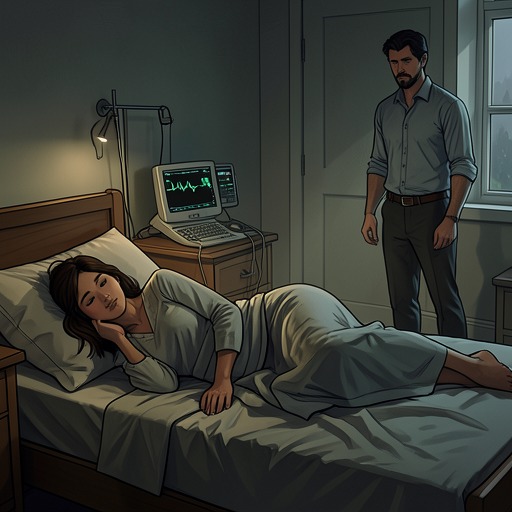
Tomas Berggren
Handling the UndeadTomas Berggren, a professor of Neurology, conducts the initial recorded interview with Eva Zetterberg after her awakening. The scene places him at the boundary between clinical investigation and an encounter that medical questions cannot readily contain: Eva can answer, but her halting self-description and fear make the interview as much a record of difficulty as a means of gathering information.
Identity and Institutional Setting
Tomas enters the narrative as a specialist assigned to examine one of the returned dead. During the night, people considered important to understanding the phenomenon are transferred to the Medical Examiner’s office at Karolinska Institute in Solna. Eva is among them because she can speak and because only a very short interval passed between the cessation of her life-sustaining functions and her awakening without their support. The account also notes that her ability to speak has steadily improved since she awoke.
Those details define the grounds on which Eva receives particular attention: her case offers both an unusual bodily interval and the possibility of verbal communication. Tomas’s interview is therefore not presented as casual conversation. It belongs to an organized attempt to understand a crisis whose subjects are being moved, observed, and questioned. At the same time, the stated improvement in speech does not mean that Eva can give a coherent account of herself or that the interview can proceed normally.
The First Interview
The interview takes place in Solna on Wednesday, 14 August 2002, from 02:56 to 03:07. Its transcript begins with Tomas identifying himself and asking Eva for her name. When he asks for her full name, the exchange establishes the basic form of the examination: short, direct questions, beginning with personal identification. The timestamp gives this conversation a precise place within the night’s institutional response, while the transcript format preserves the measured sequence of question and answer.
The recorded exchange also shows that Tomas tries to establish what Eva can communicate, not merely to collect a formal name. At one point he asks why he cannot speak to Eva. Her answer shifts from ordinary identification to a third-person account: “Eva has no ... mouth. Eva afraid.” The pauses and simplified phrasing are part of what the transcript records. Rather than supplying a fluent explanation of her condition, Eva names an absent or unusable mouth and fear, speaking of herself as Eva rather than answering from an uncomplicated first-person position.
Fear and the Limits of Questioning
Tomas follows her statement by asking why Eva is afraid. The question seeks to make fear an object of explanation, but the exchange does not yield one. Eva answers no, shakes her head violently, and refuses to answer any more questions. The refusal is a concrete end to the interview, not a resolution of what frightens her. The transcript records the boundary of what Tomas can obtain as clearly as it records his questions.
That sequence complicates the apparent authority of the clinical setting. Tomas can frame questions and the institution can classify Eva as a significant case, but neither fact guarantees access to her experience. Her words offer a fragment of self-report; her gesture and silence then restrict further inquiry. The interview makes that disparity visible without establishing whether her fear concerns the examination, her condition, or something else. Its evidentiary value lies partly in leaving that cause unanswered.
Narrative and Thematic Role
Tomas’s role is concentrated in this examination. The evidence identifies him as a professor of Neurology and the interviewer, but gives no broader personal history or independent account of his motives. His importance here comes from the encounter he conducts: he represents an effort to render the awakening intelligible through questions, while Eva’s speech and withdrawal resist being reduced to a set of answers.
The transcript’s clinical precision—location, date, start and end times—sits beside language that remains fragmentary and emotionally charged. The contrast does not make the examination pointless: it preserves what Eva can say, the question that follows, and the point at which she stops responding. But it also prevents a neat conversion of speech into explanation. Tomas’s first interview therefore documents both a developing capacity to speak and the limits of that capacity under questioning; Eva is present as a subject who answers, refuses, and remains partly unknowable.